
Picture this: Person #1 owns a seasonal business with a short window to earn 100% of yearly revenue. Their operational season is dependent on weather and economic whims; they grind away in daily business operations, with finances that are a little bit muddy and data that’s a little bit chaotic. They’re busy, but the bank account doesn’t feel busy. They’re carrying everything on their shoulders, and can’t quite figure out why things aren’t clicking – after all, they’ve intentionally built a great company, and they’ve got a competitive pricing strategy – or so they think.
Now, picture this: Person #2 owns a seasonal business with a short window to earn yearly revenue that’s still dependent on weather and economic whims. But, Person #2 is confident and educated in their financial leadership. They helm a profitable and resilient outfit, one they’ve built with intentionality and breathing room – not only operationally, but also in terms of excursion pricing.
So here’s the thing: a strong financial strategy, which includes a strong pricing strategy, creates a bridge from chaos to clarity.
This article tracks the journey of Person #1 into becoming Person #2. We’ll discuss multiple pricing strategies – including why we think they’re good, bad, or ugly – and share our “crawl, walk, run” suggestions for implementing the best fits for your business.
What Do We Want? A Leadership Mindset Shift!
“This is the way it’s always been done.”
“If I increase my prices, I’ll lose all my customers.”
“There’s no money in outfitting.”
“If I try to charge more, people will complain.”
Before we dive into the mechanics of pricing strategy, we want to first encourage a mindset shift. If you continue to do just as you’ve always done, you can expect zero things will change. Put another way: If nothing changes, nothing changes.
But, if you embrace a mindset shift, and understand that better pricing outcomes are a product of better thinking and decision habits, you can stop treading water.
When Do We Want It? Now!
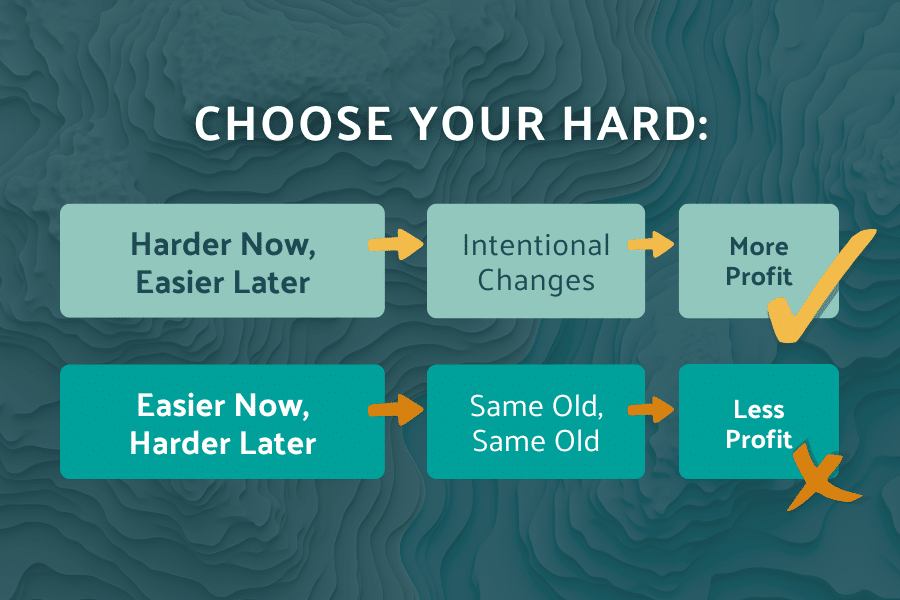
Option #1: Choose an easier route now (keeping your pricing strategy as-is, the same as it’s always been, based on competition). This will lead to hardships down the road – lower revenues, thinner margins, and honestly, just scraping by.
Option #2: Choose a slightly harder route now (and make strategic changes to your pricing strategy, no matter how uncomfortable the idea of it makes you, or how long you’ve been putting it off), and enjoy an easier time down the road. You’ll have more revenue, healthier margins, and finally get to enjoy some hard-earned breathing room.
Adopting a leadership mindset shift and embracing a new pricing strategy is hard, but immensely rewarding. Adjusting your excursion pricing is one of the fastest levers to relieve financial pressures inside a limited season, especially when volume is unpredictable.
Zebulon’s Pricing Strategy Showdown: Good, Bad, & Ugly
So what are some different pricing strategies? And why should (or shouldn’t) you adopt them?
Here’s a rundown of various pricing strategies used by outfitters nationwide, and which ones get the Zebulon stamp of approval.
The Bad & The Ugly: Competitive & Cost-Plus Pricing
These first two strategies are, unfortunately, some of the most common pricing strategies out there – if you can call anything that’s “default” a strategy! Competitive and Cost-Plus strategies are common for a reason: they feel safe. They also keep you stuck.
Competitive Pricing
Competitive pricing is an easy approach to pricing: not much research is needed to determine prices. You simply base your price off what direct competitors are charging – if they’re bigger than you, you might knock off a couple bucks in hopes your lower price point attracts some of their market share. If your competitors are smaller than you, or if you’re confident you provide a better service than them, you might charge a little more.
Ta-da! You’ve now adopted “competitive pricing.” You’ve also now unfortunately adopted a strategy that keeps you in firefighting mode and started a race to the bottom, because it undercuts competition and neglects key performance indicators of your outfit: brand, value proposition, customers, employees, and even your business’s future.
Cost-Plus Pricing
Cost-Plus is a pricing strategy that basically boils down to: Parts + Labor. We see this across almost every industry, not just outfitting. If you sum your costs (equipment, fuel & transportation, food, lodging, etc.) and tack on some labor (guide wages, office staff, owner, etc.), you arrive at a price that feels decent.
Adopting Cost-Plus pricing involves moderate levels of work, because it requires you to know and understand direct and variable costs, like cost of sales and cost of goods sold. But, just like Competitive Pricing, Cost-Plus pricing is a neglectful and incomplete strategy – not only is it seriously dated (it’s been around for centuries!), it also doesn’t consider the core functions of your business. It ignores owner needs, reserves, and the future of your business.
The Heroes of Pricing Strategy: Needs-Based and Value-Based
These next two strategies are Zebulon’s go-to’s, which build off the foundational elements we incorporate into every client relationship.
Needs-Based Pricing
Needs-Based Pricing is a Zebulon-original approach, designed specifically for seasonal outfitters. Because we look ahead to the future, and don’t dwell in the past, we start with the end in mind. This means owner pay, team pay, cash reserves, and reinvestments all figure into a Needs-Based pricing strategy.
This approach is goal-based, developed from an intrinsic understanding of what the business must produce to reward yourself, your family, and your team, while building toward your next season. You define the outcomes first, then build prices that fund them.
Value-Based Pricing
Value-Based pricing builds upon Needs-Based, incorporating the customer’s perceived value of the services you offer – which can be hard to envision without a little practice. However, your best guests – and their data – already show what they value, you’ve just got to be willing to harvest that information. (For a deeper dive on how to do this, check out The Power Of Knowing Your Value Proposition.)
Value-based pricing strategies lead to happier and more fulfilled customers, meaning better reviews, happier employees, and happier bottom lines.
The Next Frontier: Demand-Based, Dynamic, and Subscription Pricing
- Demand-Based pricing is a strategy we’re all familiar with, built on historical performance. Also called Discriminatory Pricing, Demand-Based pricing isn’t always the first move we recommend, but it can be a smart second move once the foundation is set. Demand-Based pricing considers pre-set demands, like elevating prices on weekends when space is more limited – you just know people will shell out a premium to snag the last spots on a Saturday afternoon boat. This is a static approach, in comparison to dynamic pricing, but at least Demand-Based pricing manages to shift price-sensitive guests to shoulder times while protecting peak margin.
- Dynamic pricing, on the other hand, involves real-time pricing changes based on demand, availability, and trends. Basically, your price moves as the market moves. Picture surge pricing on rideshare apps – like those increased fares after a sporting events get out – or airline fluctuations (what do you mean the $149 flight I saw yesterday is now $219?). Dynamic Pricing has plenty of potential within outfitting, but we simply haven’t experienced smooth use cases yet with current reservation tech. The ability to price dynamically is limited by the software you use, so if your tech doesn’t support it yet, don’t force it. Warning! Many reservation tech systems claim dynamic pricing when, in fact, they provide more static demand-based pricing.
- One final innovative pricing strategy for this list: Subscription pricing (i.e. memberships). By offering regulars easy access to recurring activities, you ensure a predictable stream of cash flow. When applied intentionally and with proper strategy, subscriptions can be the difference between surviving the offseason and planning it.
The Proof Is In the Pudding
Don’t simply take our word for it – adopting a new pricing strategy can be a season-altering experience.
Take for example Dave Logan, owner of Four Season Guides in Flagstaff, Arizona, who sees working with Zebulon as his business education. He’s hungry for knowledge, ready to make changes, and eager to level-up his business as the best multi-day trekking operator in the American Southwest.
However, Dave was originally “highly resistant” to adjusting his prices (his words, not ours – in fact, his first reaction to raising prices was, “Absolutely not!”). After carefully increasing his average spend by 22% (with Zebulon’s guidance, of course), his volume increased by 42%, leading overall revenue to jump by a whopping 69%.
You read that right: An increase in price resulted in increased volume. How? With Zebulon’s help, Dave aligned his price points to match what his target audience expected to pay for life-changing experiences. A higher price tag means a better perceived experience, which means more customers buying.
If you take away just one thing from this entire article, let it be Dave’s wise words at minute 35:56: “We made some pricing adjustments, and it saved our asses.” And it didn’t just change revenue, it changed confidence.
Where do I start? Zebulon’s Crawl, Walk, Run Approach
No matter what stage you’re at, there exists a logical next step to improve your pricing strategy.

The Crawl: Start Small
If you’re just getting started, we recommend changing the price of your top 1-2 offerings – the heavy hitters that drive the most revenue. This limits risk while building confidence.
As you begin to see proof that passengers aren’t turned off by the changes, we suggest making incremental changes throughout the rest of the season and to the rest of your offerings.
The Walk: Picking Up Speed
The trick here is to deeply understand your true value – your positioning, your ideal customer, and how you can deliver on the experience they want, not just the excursion. In this “walk” phase, we recommend systematically adjust all your prices, not just a few. This is like pulling off a Band-Aid, which can be temporarily breathtaking, but ultimately freeing.
The Run: Time To Take Off
We get it: It’s hard to make big changes, especially when you’re in charge of a seasonal business where everything rests on your shoulders. So, our final piece of advice to you is, simply, don’t do it alone.
If you want objective advice and a vetted process, let our finance manager Robert walk you through a pricing audit. Better yet, if you get on retainer with Zebulon, you’ll have our full suite of services at your disposal to help implement a new and innovative pricing strategy. Be like Dave – despite initial resistance, he’s now basking in breathing room thanks to an improved pricing strategy!
If you want more business education and accountability, or could simply use a fresh look at your pricing strategy, we’d love to hear from you.
FAQ: The TL;DR of Outfitter Pricing
What good outfitter pricing strategies does Zebulon recommend?
Zebulon recommends starting with solid pricing strategies like needs-based and value-based, which incorporate business goals and customer value perceptions. Other recommended pricing strategies include demand-based, dynamic, and subscriptions.
What pricing strategies does Zebulon not recommend?
Competitive and Cost-Plus Pricing are two pricing strategies that Zebulon considers to be both “bad” and “ugly” – despite them being de facto pricing methods commonly in use in the outdoor adventure industry.
What’s the difference between needs-based pricing and value-based pricing?
Needs-based pricing starts with the end in mind. You define what the outfit must produce to be healthy (owner pay, leadership pay, reserves, reinvestment), then set prices that can realistically fund those outcomes. Value-based pricing builds on needs-based pricing, but incorporates guest perception. You price your experiences based on what your best-fit customers genuinely value and will happily pay for when your offer is clear. In practice, needs-based gives you the floor (what you must charge to build a sustainable operation), while value-based helps you reach toward the ceiling (what the market will pay when you communicate and deliver real value).
What is demand-based pricing, and why is it more common than dynamic pricing?
Demand-based pricing (often called “discriminatory” pricing) uses pre-set price tiers based on historical demand patterns: weekends vs weekdays, peak departure times, holidays, shoulder seasons, etc. Dynamic pricing causes pricing changes in real time, based on current demand, booking velocity, and remaining capacity. Most outfitters prefer demand-based pricing because it’s easier to implement, and doesn’t depend on advanced software like dynamic pricing.
Will changing my prices cause me to lose customers?
If you’re willing to adopt a mindset shift and if you approach activity pricing with strategic intentionality, your outfit’s value will only grow. By setting prices on a par with the value that your ideal customers perceive, you can experience increases in volume, revenue, and your bottom line – not to mention customer satisfaction.